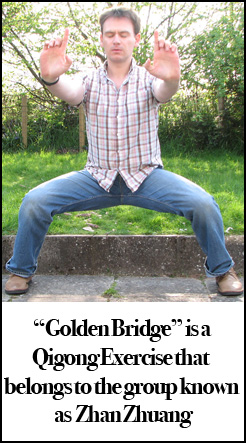
Zhan Zhuang (站桩) is a form of qigong stance training practiced across virtually every internal martial arts school. Also known as Standing Post or Stance Training, it develops internal force and deep relaxation through sustained, still postures. The two most widely practiced stances are Horse Riding and Three Circles.
What Zhan Zhuang Does: Benefits and Internal Force
Unlike most qigong exercise sets — which involve sequences of movements — Zhan Zhuang is built around a single held stance, sustained anywhere from 30 seconds to an hour. This apparent simplicity is deceptive.
The primary benefit of correct Zhan Zhuang practice is the development of internal force. Internal force can be understood as energy amplified — a quality that experienced practitioners describe as distinct from ordinary physical strength. It builds gradually through correct, relaxed practice over time.
The Three Golden Rules of Zhan Zhuang
Zhan Zhuang is not an endurance exercise. Many practitioners make the mistake of treating it as one — pushing through discomfort, tensing against the difficulty of holding a stance. This is the opposite of correct practice.
The three golden rules of Zhan Zhuang are:
- Relax
- Relax
- Relax
Qigong practice is a composite of form, energy, and mind. In Zhan Zhuang, the stance may be physically demanding — but the body, breathing, and mind must remain relaxed throughout. If the stance is wrong and the body is aching, the breathing will be affected and the mind will follow. This creates exactly the conditions that block the benefits Zhan Zhuang is meant to deliver.
Why Zhan Zhuang Must Be Learned From a Qualified Instructor
Most qigong exercise sets — such as the 18 Lohan Hands or Ba Duan Jin — contain multiple patterns. If one pattern is practiced incorrectly, the others still offer benefit. Zhan Zhuang has only one pattern. If that pattern is wrong, the entire practice is wrong.
At best, incorrect Zhan Zhuang practice wastes time. At worst, it causes harm. This is not true of most qigong exercises, and it is the reason learning Zhan Zhuang directly from a suitably qualified instructor is strongly recommended — not as a preference, but as a practical necessity. If in-person instruction isn’t accessible, learning qigong online is the closest practical alternative.
A Safety Note on Overtraining
Even when learning under qualified guidance, overtraining is a common mistake. The first sign is discomfort in the chest. If this occurs, stop the practice immediately, allow a qi flow, and consult your teacher before continuing.
Explore More Qigong Exercises
Zhan Zhuang sits within a broader family of qigong practice. To explore other exercises and sets, visit the Qigong Exercises section.