Difficulty sleeping — whether falling asleep, staying asleep, or waking unrefreshed — is one of the most common questions asked by qigong practitioners. Here are three techniques drawn from qigong practice that can help, ranging from a simple mental shift to a full body relaxation sequence.
1. Enter a Qigong State of Mind (QSoM)
A Qigong State of Mind (QSoM) is a relaxed, alert mental state that forms the foundation of all qigong practice. Applied at bedtime — simply lying in bed and entering a QSoM — it can be remarkably effective for sleep on its own.
One student, aged 83 when they began learning qigong, reported that this single skill transformed their sleep within a week of being taught it. After decades of poor sleep, they were waking refreshed and energised for the first time. QSoM was the only change they had made.
Entering a QSoM is best learned from a qualified teacher, but for a clear overview of what it involves, see the PERFECT Qigong — QSoM page.
2. Take a Trip Through Your Body
This is a full body relaxation sequence that works by moving attention systematically through the body, pausing briefly at each point to relax. Done correctly, many people fall asleep before completing the full journey.
To begin:
- Lie on your back, body symmetrical, arms by your sides
- Take 3 deep breaths — in through the nose, out through the mouth
- Bring your attention to the centre of your forehead and relax
- Move your attention to your throat and relax
Then follow this route, spending a second or two at each point before moving on:
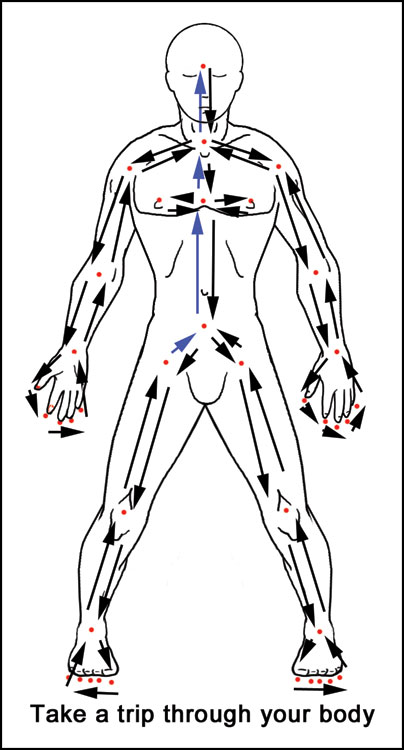
Right arm: shoulder → elbow → wrist → thumb → index finger → middle finger → ring finger → little finger → back up: wrist → elbow → shoulder → throat
Left arm: repeat the same sequence, returning to the throat
Chest: throat → sternum → right breast → sternum → left breast → sternum
Right leg: dan tien (just below the navel) → right hip → knee → ankle → big toe → each toe to the little toe → back up: ankle → knee → hip → dan tien
Left leg: repeat the same sequence, returning to the dan tien
Return: dan tien → sternum → throat → centre of forehead
The image below shows the full route visually:
The key is to stop at each point for a second or two and genuinely relax — not just pass through. It sounds more complex than it is. Most people find a rhythm quickly.
3. Lifting the Sky in Bed
If you already practice Lifting the Sky, you can use it in bed as a sleep aid. The movements will need adapting depending on the space available and whether you share your bed — being on the receiving end of an enthusiastic Lifting the Sky at 3am is not recommended for anyone involved.
The reason this works is largely associative: for regular practitioners, Lifting the Sky is so closely linked to the relaxed state of qigong practice that performing it in bed triggers that same shift in body and mind — making sleep much easier to reach.
Which Technique to Try First
If you’re new to qigong, the body scan sequence (tip 2) requires no prior experience and can be used tonight. If you already have a qigong practice, entering a QSoM at bedtime is the most direct and powerful option. Lifting the Sky in bed works best for those who already practice it regularly.