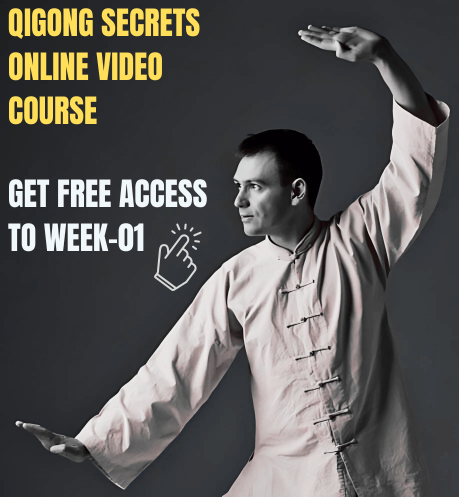
Divine Crane Starts Dancing is the tenth of the 18 qigong exercises that make up the Shaolin 18 Lohan Hands. Also known as Dancing Crane, 仙 鶴 起 舞, and XIAN HE QI WU, it is one of the more challenging exercises in the set — and one with a particularly useful connection to the body’s meridian network.
Key Benefits of Divine Crane Starts Dancing
When practiced as qigong — not merely as physical form — Divine Crane Starts Dancing offers the following benefits:
- Channels energy to the legs and promotes flexibility — also practiced as part of the Art of Flexible Legs in Shaolin Kung Fu training
- Opens up the side meridians of the body
- Through the meridian network, helps relieve problems in other parts of the body beyond the legs
- Increases longevity
How to Practice Divine Crane Starts Dancing
Begin from the Wuji stance. Raise your arms sideways to shoulder height, then step your right leg out to the side until your feet are roughly three to four shoulder-widths apart, keeping them parallel to each other.
- Bend your right knee, keeping your left leg straight, and turn your head to look towards your left hand
- Straighten your right knee again as you turn your head back to face the centre
- Repeat this 5–10 times
- Change sides, bending your left knee instead, and repeat for another 5–10 repetitions
To finish, open your arms wide, as though you were about to embrace the whole world. Lean forward slightly from the waist and sweep your arms as if scooping up handfuls of water. Then jump lightly, bringing both feet together, turn your palms to face the floor, and lower your arms slowly down the front of your body to close the exercise.
This describes the physical form. The benefits listed above come from practicing it as qigong — with a relaxed, present state of mind and genuine attention to energy flow, not just movement.
A Common Form Mistake to Avoid
A widespread misconception with this exercise is that going lower in the stance is better. It isn’t. Students frequently sacrifice correct form in order to lower themselves further — and in doing so, undermine the exercise entirely.
Form is the least important of qigong’s three components, but it is still important. If you are straining, overexerting, or losing the structural integrity of the movement, you are no longer doing qigong — you are doing physical exercise. Use only as much depth as allows you to remain relaxed and in good form throughout.
An Important Note on Form vs. Qigong
The benefits above are only available when this exercise is practiced as qigong — with a Qigong State of Mind (QSoM) and genuine energy flow. Practicing the physical movements alone — the form — will not produce these results. The form is not the art of qigong.
Learning Divine Crane Starts Dancing directly from a qualified qigong instructor is strongly recommended, particularly given the technical demands of maintaining correct form at depth. If that isn’t possible, your next best option is to learn qigong online. Divine Crane is taught in full in my online course.
Next in the 18 Lohan Hands
The next exercise in the set is Second Son Carrying Mountains — exercise 11 of the 18 Lohan Hands.