Category: Qigong

  • Qigong and Weight Lifting — Can You Do Both?

    For years, a common position among qigong teachers was that weight lifting and qigong practice don’t mix — that tension in large muscles makes it harder for Qi to flow. It’s a view worth examining directly, because the practical reality is more nuanced.

    The Traditional Concern — and Why It May Be Overstated

    The philosophy behind the warning is that Qi finds it harder to move through tense or heavily developed muscle. In theory, this sounds reasonable. In practice, it doesn’t hold up as a blanket rule.

    Two years of regular calisthenics — heavy bodyweight training, three sessions a week — alongside consistent qigong practice produced no detectable detriment to Qi development. If anything, the combination produced the opposite effect: greater strength, better fitness, and improved overall vitality.

    The human body has evolved to benefit from three types of physical exercise:

    • Walking — most people spend too much time sitting
    • Heavy lifting — kept to 30–45 minutes per session
    • Sprinting — or High Intensity Training as a practical alternative

    Qigong is not a reason to give up exercise you enjoy. If anything, a regular qigong practice should make you better at physical training — not require you to abandon it.

    How to Combine Qigong and Weight Training Practically

    The one practical guideline worth following: leave a minimum 30-minute gap between your qigong practice and your weight training session. The two activities require very different mental and physical states. Qigong demands relaxation, inward attention, and a Qigong State of Mind (QSoM) — the exact opposite of what effective weight training requires. Mixing them without a gap dilutes both.

    Beyond that, the order is less important than the gap. Some practitioners prefer qigong first; others find weight training first works better for them. Try both and observe the difference in your practice quality.

    The Broader Principle

    Qigong should complement your life, not restrict it. The PERFECT Qigong system is built around this idea — a 15-minute daily practice that fits around existing commitments, including physical training. If you combine qigong with good exercise and nutrition, you have a strong foundation for a healthier, longer life.

    For more on getting started with qigong alongside an existing fitness practice, see learning qigong online or explore the 18 Lohan Hands exercise set.
  • Qigong for Sleep: 3 Techniques for a Better Night’s Rest

    Difficulty sleeping — whether falling asleep, staying asleep, or waking unrefreshed — is one of the most common questions asked by qigong practitioners. Here are three techniques drawn from qigong practice that can help, ranging from a simple mental shift to a full body relaxation sequence.

    1. Enter a Qigong State of Mind (QSoM)

    A Qigong State of Mind (QSoM) is a relaxed, alert mental state that forms the foundation of all qigong practice. Applied at bedtime — simply lying in bed and entering a QSoM — it can be remarkably effective for sleep on its own.

    One student, aged 83 when they began learning qigong, reported that this single skill transformed their sleep within a week of being taught it. After decades of poor sleep, they were waking refreshed and energised for the first time. QSoM was the only change they had made.

    Entering a QSoM is best learned from a qualified teacher, but for a clear overview of what it involves, see the PERFECT Qigong — QSoM page.

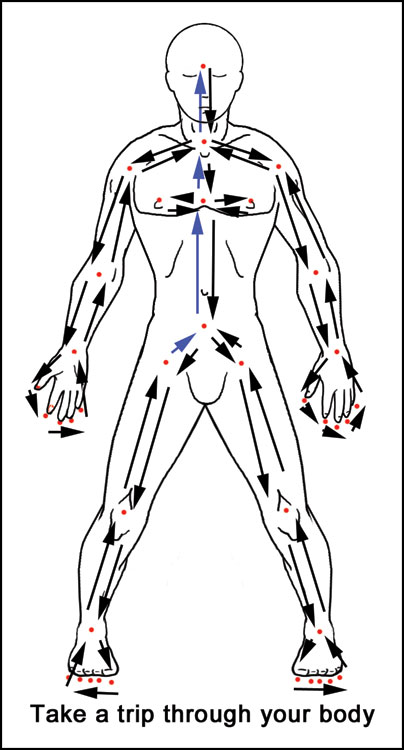
    2. Take a Trip Through Your Body

    This is a full body relaxation sequence that works by moving attention systematically through the body, pausing briefly at each point to relax. Done correctly, many people fall asleep before completing the full journey.

    To begin:

    1. Lie on your back, body symmetrical, arms by your sides
    2. Take 3 deep breaths — in through the nose, out through the mouth
    3. Bring your attention to the centre of your forehead and relax
    4. Move your attention to your throat and relax

    Then follow this route, spending a second or two at each point before moving on:

    Right arm: shoulder → elbow → wrist → thumb → index finger → middle finger → ring finger → little finger → back up: wrist → elbow → shoulder → throat

    Left arm: repeat the same sequence, returning to the throat

    Chest: throat → sternum → right breast → sternum → left breast → sternum

    Right leg: dan tien (just below the navel) → right hip → knee → ankle → big toe → each toe to the little toe → back up: ankle → knee → hip → dan tien

    Left leg: repeat the same sequence, returning to the dan tien

    Return: dan tien → sternum → throat → centre of forehead

    The image below shows the full route visually:

    Body relaxation sequence for qigong sleep technique

    The key is to stop at each point for a second or two and genuinely relax — not just pass through. It sounds more complex than it is. Most people find a rhythm quickly.

    3. Lifting the Sky in Bed

    If you already practice Lifting the Sky, you can use it in bed as a sleep aid. The movements will need adapting depending on the space available and whether you share your bed — being on the receiving end of an enthusiastic Lifting the Sky at 3am is not recommended for anyone involved.

    The reason this works is largely associative: for regular practitioners, Lifting the Sky is so closely linked to the relaxed state of qigong practice that performing it in bed triggers that same shift in body and mind — making sleep much easier to reach.

    Which Technique to Try First

    If you’re new to qigong, the body scan sequence (tip 2) requires no prior experience and can be used tonight. If you already have a qigong practice, entering a QSoM at bedtime is the most direct and powerful option. Lifting the Sky in bed works best for those who already practice it regularly.