Energy flow — also called Qi flow or Flowing Breeze Swaying Willows — is the second of the three core skills of qigong. It’s also the most misunderstood. This page explains what it actually looks like in practice, why it varies between practitioners, and what to expect when you’re starting out.
Video: Energy Flow in Practice
The video below shows a typical energy flow session. What you’re seeing is not performance or choreography — it’s the body moving in response to qi flowing to where it needs to go.
One thing to notice: this is a gentle example. Energy flow comes in many forms — from barely perceptible swaying to more pronounced movement, depending on the practitioner and the blockages being cleared. Your own experience will be unique to you.
What “Let Go — Do Nothing” Actually Means
The instruction during energy flow is simple: let go and do nothing. This means not directing the movement, not deciding where the qi should go, and not making anything happen. The key is to let everything be done for you.
Most students during energy flow are not making themselves sway, not making themselves cry or laugh, and have not lost control. They are simply letting their qi flow to where it needs to go — allowing the healing, the energising, and the removal of blockages to happen naturally.
It’s as simple — and as difficult — as that.
Why Energy Flow Looks Different for Everyone
Energy flow is a skill, and like all skills, it develops over time. The diagram below illustrates the general pattern:
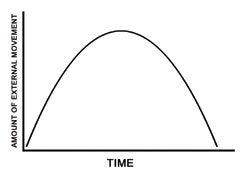
In the early stages, beginners often barely move at all — this is completely normal. As practice continues and the skill of letting go develops, movement tends to increase. This reflects the qi finding and clearing blockages. Over time, as blockages are resolved, external movement gradually settles again — until, in advanced practice, energy flow may appear as a gentle swaying similar to a beginner’s, though the internal experience is vastly different.
This is a general pattern only. Some practitioners experience pronounced movement early on; others remain still throughout and experience energy flow primarily as internal sensation. Neither is better or worse.
How to Develop the Skill of Energy Flow
Energy flow is not something you can force or manufacture. It emerges naturally when the first core skill — entering a Qigong State of Mind (QSoM) — is established correctly. Without genuine relaxation and mental stillness, energy flow is limited.
This is why energy flow is best learned directly from a teacher who has the skill. You can observe it, read about it, and watch demonstrations — but the transmission of the skill itself happens in practice, with proper guidance.
To learn energy flow as part of a structured qigong practice, take a look at my online course — available to try for free.