I consider the two words I’m about to share with you, the most important words in Qigong.
If you’ve been part of the Qigong15 tribe for a while you’ll be very familiar with them.
And if not, all is about to be revealed.
Here they are:
Relaxed
Gentle
Impressive huh?
What, you don’t agree?
Okay, let me explain.
Your movements are relaxed and gentle.
Your breathing is relaxed and gentle.
Your mind is relaxed and any thoughts are gentle.
Capiche?
There’s a simple little exercise I’d love to share with you, one that would really make this concept come alive for you in a way you’ll never forget.
But I’m sorry to say I’m in London right now and I simply don’t have the time to spare.
However, if you’ve already got a copy of my book: Shaolin Chi Kung – 18 Exercises to Help You Live a Longer, Healthier and Happier Life. You’ll find the exercise in Section 5: Practical Advice on page 130.
In the same section you’ll also discover:
Trouble shooting tips for some of the most common problems Qigong Players experience with their practice.
How to live for 120 years.
How to deal with disturbances during your practice.
How to really speed up your healing process.
The Top 10 Qigong Do’s and Don’ts
And there’s even a little bit about Qigong and sex.
Heck, the other 140 pages are packed full of Qigong goodness too.
Full details and immediate download available here:
I truly believe that chi kung, practiced as chi kung and not chi kung form, is more powerful and gives better physical, emotional, mental and spiritual results than Yoga, Tai Chi and Reiki – combined! Of course that’s just my opinion based on my personal experience, so there’s no need for us to fall out about it =)
But, I have to admit there are 2 major flaws of chi kung. These flaws are serious and it is my job as your guide to the chi kung world to let you know about them, regardless of whether you are already practicing chi kung, or plan to start practicing chi kung.
Here they are:
Major Chi Kung Flaw #1
It takes time – much of what you see written about chi kung is so sensational. You could easily be forgiven for thinking that chi kung is some kind of 30 day miracle cure. Some of the claims made would lead you to think that there is nothing that chi kung can’t do. Well, most of the claims are true – but it takes daily, preferably twice daily, practice of chi kung (and not chi kung form) over a period of around 4-6 months for you to notice significant improvements in long term, deep rooted illness or disease. It is true that practiced correctly you will feel relaxed, peaceful, energised and generally all round ‘better’ immediately after you finish a chi kung session – but you must realise that you won’t make massive changes to your health or vitality overnight.
Major Chi Kung Flaw #2
You have to do the work – a teacher can point the way, but you must make the effort yourself. There is a joke that chi kung is for lazy people. And when compared to the discipline and effort involved with learning Tai Chi Chuan and Shaolin Kung Fu this is absolutely true. But practicing chi kung requires the disicipline and commitment to practice every single day. Reading about chi kung, watching chi kung/qigong dvd s will not benefit you one single iota. As my teacher is fond of saying: we don’t learn chi kung we practice chi kung. In the west we have become a nation that believes there is a pill for every ill. We are used to handing over the responsibility for our health and well being to ‘experts’. Got a belly ache? Take a tablet. Feeling down? Take a tablet. Or better yet, I’ll go to the doctor and get some hardcore tablets. The massive pharmaceutical giants want you to believe there is a pill for your every ill because that’s how they make billions of $’s profits every year. But that’s for another post!
In a Nutshell – if you want instant cures and you want someone or something to do the curing for you then please do not waste your precious time with chi kung. You simply will not get the results that you want. But if you are prepared to invest 15-30 minutes a day and want to take back responsibility for your happiness, health and well being – then chi kung has much to offer you.
Let’s get one thing out in the open before we begin. I’m obviously biased. I’ve been practicing Qigong for well over a decade, I’ve been teaching it since 2004, I’m an author of a book on Qigong, I was the chief instructor in the UK of a world wide institute that teaches Qigong, I’m the creator of an Online Qigong Course available via the Internet and founder of the Qigong15 — dedicated to the spread of ‘fluff free’ qigong goodness.
In my defence I first began practicing Tai Chi whist at University between 90-93, I practiced it again between 1995 and 2000 with the Wutan school whilst living in Nottingham. I was in the process of being taught how to teach Tai Chi for Wutan when I found Grandmaster Wong Kiew Kit and made the very difficult decision to leave Wutan and begin my training with the Shaolin Wahnam Institute (founded by Grandmaster Wong Kiew Kit).
Over the next 9 years whilst practicing Shaolin Kung Fu and Shaolin Qigong I had a number of opportunities to attend special ‘invitation only’ combined Tai Chi Chuan and Shaolin Kung Fu intensives. And can testify to the incredible combat efficiency of Tai Chi Chuan when it is practiced as a martial art and not as Grandmaster Wong Kiew Kit calls it: ‘Tai Chi dance’.
I share this information with you, not to brag, but in the desire to demonstrate that I know what I’m talking about when discussing Tai Chi and Qigong.
The next confession I’d like to make is that if you are practicing Tai Chi Chuan as a martial art and you enjoy practicing it as a martial art then you probably shouldn’t waste your time reading the rest of this article.
But if you are practicing Tai Chi primarily to gain it’s health and vitality benefits then I’m going to spend the next 1712 words explaining why your time and energy is better invested in Qigong than Tai Chi.
With that in mind, let’s get started.
Why do people practice Tai Chi? Let’s have a look at some of the main reasons:
To improve physical health
To reduce the negative effects of stress
To live a long, active life
Spiritual cultivation
Let me quickly give you an explanation of what qigong is, though if you’re a Tai Chi practitioner, I’m confident you will have heard of it.
Qigong is the art of deliberately working with your bodies vital energy (qi/chi/ki). (Most) Qigong is a composite of slow external moves co-ordinated with the breathing, performed in a meditative state of mind. What does that sound like? Tai Chi?
Why do people practice Qigong? There are 5 main reasons:
To improve health and increase energy/vitality
To increase Longevity
To develop internal force (think of it as energy+ usually favoured by martial artists)
To improve mental clarity
For Spiritual cultivation.
Again, that list looks pretty similar to the one which looked at the main reasons why people, you included, practice Tai Chi.
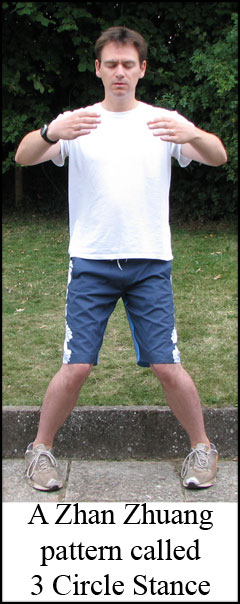
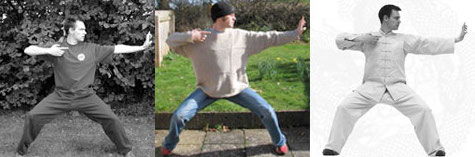
In my opinion the only significant reason you would practice Tai Chi instead of Qigong is if you are practicing it as a martial art. Now Qigong will be useful for you as a martial artist in developing internal force. I’d even go on a limb and say that if you practice Tai Chi for martial reasons then you’ll be very familiar with the Zhan Zhuang exercise known as ‘Three Circle Stance’.
Assuming though that you are still reading this article because you practice Tai Chi mainly for health benefits then I’d like to tell you that Qigong is much easier to learn than Tai Chi.
Let me explain.
Q: How many patterns are there in the Tai Chi form your are learning? Probably anything from 24 to 108+ depending on what ‘style’ you are learning. How long did it take you, or how long is it taking you to, to learn all of these patterns and be able to move smoothly and flowingly from one to the other?
From my experience of having the opportunity to learn Yang (short and long form), Sun and Chen style I would have to say it takes months just to be able to remember what ‘move’ comes next.
Then it takes many more months to flow effortlessly from one pattern to the next. I remember taking many months to be able to move competently from Snake Creeps Down to Golden Cockerel Stands on One Leg.
So, even when you know which pattern comes next, being able to ‘flow’ there with good form, energy and mind can take an age to learn.
Then we get into ‘hardcore’ Tai Chi theory territory. The realms of Yin and Yang, avoiding being double Yang and Tai Chi philosophy. If you’re a practitioner of Tai Chi then you already know that Tai Chi is considered a Taoist art. And to be blunt, those Taoists can be deliberately confusing individuals!
I personally found that when I attempted to bring Tai Chi philosophy to my Tai Chi practice, I invariably ended up feeling confused, confused, confused. Oh, and often frustrated as well.
The material written in many books and spread by many teachers is just down right nonsense, usually interpreted incorrectly from ancient Taoist texts. Texts which were deliberately written in a way that assumed that you were a student, familiar with many of the esoteric terms, under the tutelage of a master and not just some dude with 20 bucks in your pocket wandering into Barnes & Noble.
In contrast, Shaolin Qigong philosophy is incredibly simple. It is based on the theory of Traditional Chinese Medicine. What follows is a very simple overview of Qigong:
Qi/Chi/Ki flows through the body along streams known as the meridians. Blockages to the smooth flow of qi through the meridians result in illness.
Qigong seeks first to clear these blockages, thus promoting smooth qi flow which results in good health. As we continue our practice of Qigong our qi flow becomes vigorous which results in good health and vitality. Eventually we have an abundance of qi flowing through the meridians and this results in good health, vitality and longevity. In short you live a happy, healthy and long life.
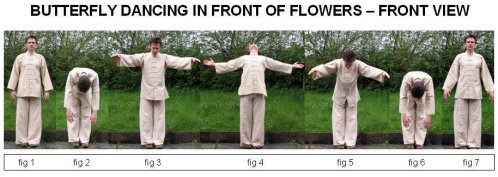
A Qigong exercise usually consists of an average of 5 or 6 ‘moves’ (see the diagram below):
Which means you can learn it so much quicker than Tai Chi and means therefore that you can start getting the benefits so much quicker as well.
Q: How long does it take you to do your Tai Chi practice? Now I realise this will vary wildly depending on how ‘serious’ you are. If you only practice when you go to class then you may only practice an hour a week. If this is you, then I hate to tell you this, but when it comes to achieving health and energy – you’re wasting your time.
Both Tai Chi and Qigong are not some 30 day miracle cure. Despite what some of the adverts would have you believe. No. If you want results, you must practice daily.
Now when I practiced Tai Chi, I used to practice a minimum of 30 minutes a day and attend classes 3 times a week.
So with Tai Chi, not only do you have the huge investment of time learning a form, but then you have to invest time practicing that form, so that you can co-oridinate your hands with your feet, your elbows with your knees and so on.
Well with Shaolin Qigong you need only practice for 15 minutes a day to get the 5 main benefits that I listed earlier. Not only do you save massive amounts of time by only having to learn the few ‘moves’ that make up the qigong exercise you’re practicing, but you only have to practice it for 15 minutes a day.
Trust me, Qigong practitioners make a substantial ‘Time’ saving compared with Tai Chi practitioners whilst getting health and energy benefits quicker. It’s a double result.
In fact the simplicity of Qigong in comparison to Tai Chi, means that Qigong practitioners can quickly focus on developing the 3 core skills of qigong. And remember it is skill that makes the difference between a beginner and an expert. It is skill that allows you to access the 5 main benefits of qigong and live a happy, healthy and long life.
Personally, I believe that time is one of the most precious and valuable ‘commodities’ that we possess. When it’s gone, it’s gone. What we do with our time dictates the results we get in our lives.
Finally I would go out on a limb and say that if you want to get the wonderful health and vitality benefits of Tai Chi (and don’t get me wrong, they really are wonderful if you have the time to get them and a good teacher to guide you) then you have to practice Tai Chi as a martial art or as Tai Chi Chuan (Taijiquan). Yet so very few people do.
When I first began learning Tai Chi at university I was rather confused. I had read that Tai Chi Chuan meant ‘Supreme Ultimate Fist’, I had read that it was a formidable ‘internal’ martial art. And yet I could not comprehend how the slow, gentle, graceful movements could realistically help you to defend your self against an ugly street fight encounter.
But such matters are outside the scope of this article, the point I wanted to address is that to get the best health, energy, vitality benefits from Tai Chi you have to practice it as a martial art.
Conclusion
If you are practicing Tai Chi solely for health reasons then qigong is a better option because:
There are fewer moves to learn
The theory is much simpler
It takes a lot less time to practice
It’s easier to develop the necessary skills to promote health
You don’t need to practice it as a martial art to get its best benefits
Isn’t it time you considered making the switch to Qigong?
There are five primary reasons why individuals choose to practice qigong.
Health and Vitality: Qigong is literally the art of managing your vital energy. Vital energy, or chi/qi, is what keeps you and me alive. Qigong means energy work, and it works directly on your energy. Qigong is based firmly on the concepts of traditional Chinese medicine (TCM). In a nutshell, your energy flows through meridians. If these meridians are blocked, illness results. It depends on the severity of the blockage. If the blockage is enough to stop the flow of chi, qi, or energy completely, death rapidly follows! The first aim of qigong is to remove these energy blockages, and the great thing about qigong is that unlike acupuncture, tui na, herbs, and diet (the other main branches of TCM), you don’t need to know where these energy blockages are. Practice high-level qigong, and your chi or qi will naturally flow to these areas of blockage (low energy) and work on removing them. Qigong really is that clever! With the clearing away of blockages, health and vitality are the results.
Longevity, the forte of qigong, is in two parts. The first is to remove blockages and promote health and vitality. But qigong, practiced daily and correctly, will also increase longevity. How? Well-smooth chi flow through the meridians (energy channels) of the body = good health. When the flow is strong, you have vitality, and when you have an abundance of energy (chi or qi you will live a long, healthy, and happy life. But keep in mind that qigong is not some 30-day miracle cure! No, to get these benefits of qigong, it must be practiced correctly every single day.
Internal Force: think of this as energy+. It’s what allows you to wake up in the morning feeling good to go. Work hard all day, come home at the end of the day, and still have plenty of time to get up and go left to enjoy your time with family or friends. It can also be used by martial arts practitioners to make them more effective in combat. It is very common for qigong to be practiced by martial artists. But the type of qigong practiced is usually different as they have different needs.
Mind Expansion: Qigong is great for scholars and creatives. Imagine being able to tap into more of your natural talent. Qigong helps to clear the mind of useless clutter. The practice of qigong allows you to focus your mind. Think of your mind as the sun, and think of qigong as a magnifying glass. Put the two together, and you have great power!
Spiritual Cultivation: Let‘s get one thing straight right from the start. Qigong is non-religious. Practitioners of any religion, or those who don’t practice a religion, can practice qigong and gain its benefits. By spiritual, I mean that inner part of you that makes you uniquely you. Qigong helps you cultivate that part of you. We all have a spiritual side to us, and sadly, it is often the most neglected part. Personally, I believe that is why illnesses like depression, anxiety, and stress are so rampant in our society today. We seem to place little or no value on spirit. Practice qigong, and whether you believe you are a spiritual being or not, you will protect yourself from depression and anxiety and increase your resistance to stress.
Ever been curious about why some practitioners use the word Qigong, while others use Chi Kung? Or maybe you’ve stumbled upon variations like Qui Gong, Chi Gung, or Chi Kong and wondered if these all refer to the same discipline? This informative blog post is dedicated to providing clarity around these terms.
Even if you haven’t asked these questions yet, you’ll undoubtedly find something intriguing here. Let’s explore this fascinating topic together.
Looking back to my first book, “Shaolin Chi Kung,” penned in 2008, you’ll notice that I used the Wade-Giles rendering ‘Chi Kung’ rather than the Romanized ‘Qigong.’ But these days, I primarily use Qigong.
The reason? Simply put, the term “Qigong” is more frequently searched online than “Chi Kung.” As a professional Qigong instructor, it’s practical to position my ‘virtual stall’ where the majority of traffic lies.
Sure, I could write Qigong/Chi Kung all the time, but that’d grow old real quick.
So, is Qigong the same as Chi Kung?
Indeed, they are.
In fact, Qigong is a contemporary term for the ancient Chinese energy arts, previously known as Nei Gong.
Yet, Nei Gong is only half of the story. The other half is Wei Gong.
Wei Gong and Nei Gong are the two groups that the legion of Kung Fu force training arts are usually divided into. Where:
Wei Gong is used to refer to External Force Training arts. Wei Gong trains Jin, Gu and Bi or muscles, bones and flesh. It utilizes techniques such as stretching, hitting objects or using weights.
Nei Gong is used to refer to Internal Force Training arts. Nei Gong trains Jing, Qi and Shen or essence, energy and spirit. These arts utilise techniques like: Zhan Zhuang, meditation, Dynamic Qigong exercises.
The style of Qigong I teach falls under the Nei Gong category.
Considering the different Chinese dialects, such as Mandarin and Cantonese (widely spoken by Chinese communities in the West), and the scope for human error, it’s understandable why there are so many ways to refer to these Chinese energy arts.
Regardless of the spelling you choose for your Qigong practice—whether it’s Qigong, Chi Kung, Nei Gong, Qui Gong, Chi Gong, Chi Kong, or something else entirely—it’s not worth stressing over. The primary focus should be on whether your practice yields the results you seek.
If you’re not seeing the outcomes you desire, you might be practicing Qigong form only. There’s nothing inherently wrong with this, but it may not be the most effective use of your time, energy, and resources.
If you’re interested in learning Qigong the way I teach, which I learned directly from Grandmaster Wong Kiew Kit, I created an online course you can follow from home.
Qigong works by managing the flow of vital energy — called Qi — through the body. Qi is the force that keeps the body’s systems functioning. When it flows harmoniously, the result is good health. When it is blocked, illness follows. Qigong practice addresses this directly.
The Three Stages of Qigong Practice
The mechanism behind qigong operates in three progressive stages:
Remove blockages — Illness develops when vital energy cannot flow harmoniously through the body’s meridians (energy streams). The severity of illness corresponds to the severity of the blockage. Qigong practice first works to clear these blockages, whatever their origin — physical, emotional, mental, or spiritual.
Restore harmonious flow — Once blockages are cleared, energy flows freely through the meridians again. This is the foundation of good health. A practitioner at this stage feels well, functions well, and is free from the conditions that blockages produce.
Build vitality and longevity — Beyond harmonious flow, qigong practice can develop an abundance of energy. This is where vitality deepens, resilience builds, and the conditions for a longer, healthier life are established.
How Long Does This Take?
Qigong is not a 30-day cure. It is an art, and like any art the results depend on the quality and consistency of practice. Correct daily practice — even for just 15 minutes — is what moves a practitioner through these stages over time.
The Role of Correct Practice
The mechanism above only operates when qigong is practiced correctly — as a genuine art, not merely as physical movement. This distinction matters more than it might seem. Practicing the form without the corresponding energy and mind components produces far more limited results.
Ideally, qigong is learned directly from a qualified teacher. For those without access to one, the Qigong Secrets online course is the closest alternative to direct instruction. To explore the exercises themselves, visit the qigong exercises section.
Qigong (also written as chi kung) is the ancient Chinese art of deliberately managing your vital energy. In practice, it combines gentle external movements with coordinated breathing, performed in a meditative state of mind. It is the oldest of the five main branches of Traditional Chinese Medicine, with a history spanning over 5,000 years.
If you’ve never heard of it before, you’re not alone — but you’re in the right place.
What the Word Means
The word itself points directly at the practice. Split into two:
Qi — energy (specifically, vital energy: the force that keeps the body’s systems functioning)
Gong — work, or skilled practice
Qigong, then, literally means “energy work” — the deliberate cultivation and management of the body’s vital energy.
How Qigong Works
Qigong works in two stages:
It removes blockages to the harmonious flow of energy through the body’s meridians (energy streams), restoring Yin-Yang harmony. Whether a blockage is physical, emotional, mental, or spiritual in origin makes little difference to qigong’s effectiveness.
Once blockages are cleared, qigong increases the strength of energy flow through the meridians — promoting vitality, health, and longevity.
For a deeper look at the mechanism behind this, see How Qigong Works.
Why People Practice Qigong
There are five main reasons people choose to practice qigong:
Health and vitality
Longevity
Internal force (best understood as abundant, directed energy)
Mental clarity
Spiritual cultivation
What Makes Qigong Accessible
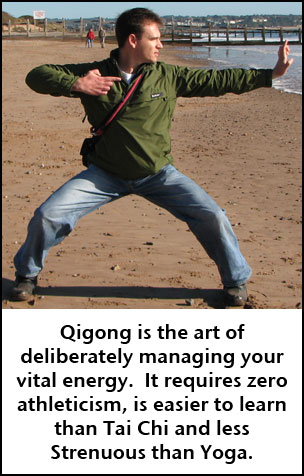
Unlike many forms of exercise, qigong requires zero athleticism and no equipment. It is easier to learn than Tai Chi and less physically demanding than yoga. If you have 10 to 15 minutes a day, you can practice it — regardless of age, fitness level, or prior experience.
Is Qigong Still Relatively Unknown?
In the West, yes — for now. Ask a room of 100 people whether they’ve heard of yoga, and every hand goes up. Ask the same about Tai Chi, and most hands follow. Ask about qigong, and typically only a handful respond. That gap is closing, but it means most people arrive here with no prior frame of reference — which is exactly why this site exists.
Where to Go Next
If you’re new to qigong, a good next step is to explore the qigong exercises covered on this site, or to read about how qigong works in more depth. For structured learning, the online course is the most direct path.
Give me 3 minutes and I’ll explain why 98% of Qigong practitioners are wasting their time…
Remember, Qigong is the art of deliberately managing your vital energy or Chi/Qi. Vital energy is the ‘juice’ that keeps you alive and allows you to do everything you do.
Qigong is similar to Yoga, but less strenuous
It’s like Tai Chi, but easier and quicker to learn
It offers proven health benefits and requires zero athleticism
There are 5 main aims that people practicing Chi Kung/Qigong exercises want to achieve:
Improve Health and Increase Vitality
Longevity
Develop Internal Force
Mind Expansion
Spiritual Cultivation
But I’d say about 98% of qigong practitioners today are wasting their time because they do not practice the 3 core skills of Qigong.
If you want to succeed with Qigong you need to practice, practice, practice these 3 core skills.
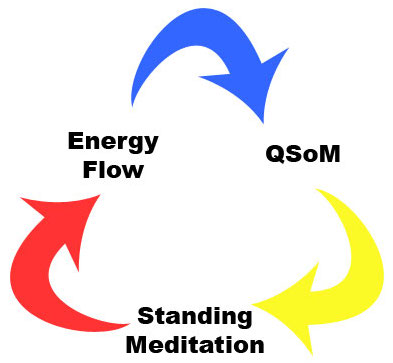
The 3 Core Skills of Qigong. Without them you’re doing gentle exercise…
So what are these 3 core skills that hardly anybody knows about?
1) Entering a QSOM — think of it as a higher state of consciousness. It’s about being relaxed and focused.
Listen if you can’t relax, you can’t do qigong. Even though many people start practicing qigong to be able to relax, and that’s a really good reason by the way, relaxation is just the start of qigong.
To enter a QSOM you have to be able to relax physically, emotionally, mentally and spiritually.
2) Energy Flow — more poetically known as ‘flowing breeze, swaying willows’
It is one of the most closely guarded, jealously kept secrets of qigong and that’s a real shame because energy flow is what makes qigong such a powerful tool for health and vitality.
If energy flow is not part of your qigong practice then you’re missing out on at least 75% of the benefits of qigong.
3) Standing meditation — this helps to consolidate your practice and that’s all I want to say about it here, otherwise we’d be here for hours.
Seriously if these 3 core skills are not part of your daily qigong practice all you’re doing is low level exercise and if that’s what you want to do you might as well do the washing up, because at least you’re getting something useful done at the same time.
Whether you’re practicing medicinal qigong, dynamic qigong, qigong for marital arts, or super hardcore qigong like small or big universe, you need to be practicing the 3 core skills of qigong to gain maximum benefit from the time and effort you invest in your practice.
If you’re not you’re leaving most of the goodness of qigong on the table.
In the 22 week Qigong Secrets Home study course I cover these 3 core skills in great detail — but the truth is, the best way to learn these vital core skills of qigong is directly from me or from a teacher who knows and practices them.
Because Qigong is an art it is the skills that are important. Certainly more important than the number of qigong exercises you know. It is mastery of these 3 core skills that allows you to get more benefits in just 15 minutes of daily practice than most qigong practitioners, worldwide, get in an hour.
The sad truth is that most people practicing Qigong today are not actually practicing Qigong.
To be specific they are practicing what I call Qigong form only. Why is this a problem?
Well let’s take a closer look. It is well known that the practice of Qigong gives the following 5 main benefits:
Health and Vitality
Longevity
Internal Force
Mind Expansion
Spiritual Cultivation
But, many people who practice Qigong do not get these benefits because they have been practicing Qigong form and then, because they think they have been practicing Qigong they believe Qigong doesn’t work.
The truth is that Qigong form doesn’t work, apart from giving your body a gentle stretch and increasing blood flow. And whilst these can be beneficial activities in themselves they are considered ‘minor league’ when compared to the 5 benefits I’ve listed above. If you’re going to invest your time, and money in Qigong, make sure you’re practicing Qigong and not Qigong form.
So, what is the difference between Qigong and Qigong form and how can you tell if what you are practicing is indeed Qigong?
Qigong Vs Qigong Form — Can you tell the difference?
Let’s start by recapping what Qigong is:
Most Qigong is a composite of gentle external movements (qigong form), coordinated with the breathing and performed in a meditative state of mind, also known as a Qigong State of Mind (QSOM).
Entering a QSOM – Think of this as entering a higher state of consciousness, at it’s lowest level it means being relaxed and focused.
Energy Flow – Qigong form, performed in a QSOM, combined with the correct breathing results in Energy Flow. More poetically known as ‘Flowing Breeze Swaying Willows’ it is where the healing takes place. If your qigong practice does not have energy flow, then you’re are leaving virtually all of benefits to be had from the practice of Qigong on the table.
Standing Mediation – Consolidating the results of your practice.
If your practice consists of moving from one qigong exercise to the next qigong exercise, often taking 30 minutes plus a session and has no Energy Flow then you are very likely practicing Qigong form and will not get the benefits of Qigong.
How can you tell if what you are practicing is Qigong?
You know if you are practicing Qigong because not only does it help you to overcome pain and illness, but it also makes you healthy and full of vitality. If you’ve been practicing for 3 months or more and haven’t’ noticed any improvements in your health, vitality, resistance to stress, etc then chances are you are practicing Qigong form only.
If you are practicing Qigong you will also feel energised at the end of your practice and not tired.
Why?
Because Qigong generates energy, whereas physical exercise uses energy.
What else?
Recall at the start where I wrote that Qigong is a composite of form, energy and mind? If you are only practicing form, then it is logical that you will only get the benefits of practicing form, which as already mentioned are similar to those of gentle exercise. Qigong has always been rare, whilst Qigong form is very common and easily available.
If after reading this post, you’ve decided you’d like to learn Qigong, I suggest you check out my digital Qigong course.
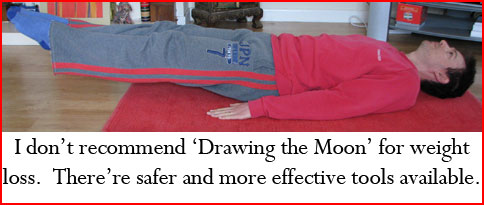
Back in 2007 there was discussion, in the school I was with, about using a Qigong exercise known as ‘Drawing The Moon’ as the basis for a Qigong weight loss program.
The idea was that by the time you could perform ten, 30 second rotations in each direction, you’d have to change your wardrobe because you’d lose so much weight from around your waist.
Personally, the problem I had with this specific Qigong exercise was that no matter what I did, it caused me so much lower back pain I had to stop practicing it.
Back pain aside, there was something else that bothered me about ‘Drawing The Moon’ as a Qigong solution to weight loss.
You see in 1996 I qualified as a personal fitness trainer with the YMCA and I discovered something that doesn’t appear to be common knowledge.
Want to know what it was?
Fat is not spot related.
What does this mean?
It means that whilst sit ups, crunches and Drawing The Moon could help you to develop fantastic abdominals (though if you want to avoid back pain and still build strong abs I recommend leg raises instead), none of them will help you to lose belly fat. You might be able to build some epic abs, but nobody will ever see them if they’re hidden under a layer of fat.
Losing Weight is Simple
First let’s clear something up. It’s an important distinction that will help you further down the road.
I’m betting you don’t actually want to lose weight, what you want to lose is fat.
Am I correct?
Thought so, okay, let’s continue then with this distinction in mind because my research has convinced me that losing fat is simple.
The ‘equation’ is this:
Use more calories each day than eat and over a period of time you will lose fat.
I guarantee it.
But there’s a catch: I said it was simple, not easy.
And if you’ve ever tried to lose fat before then I’m sure you’ll agree with me that it isn’t easy.
Here’s why…
If you are carrying more fat than you would like, chances are the extra fat didn’t arrive over night. It came gradually over many months and years. So, realistically what do you think your chances are of losing fat, safely and healthily in a short period of time?
You’re right, slim to none.
Moving on…
Now I don’t know about you, but when I hit 40 something changed for me. I won’t call it a mid-life crisis, that’s a bit dramatic. But I certainly felt an ‘itch’ that couldn’t be scratched. Along the lines of:
“Is this it? Is this all I’ve achieved with my life?”
I joke with my friends that I couldn’t afford a Porsche, so I decided to do that other stereotypical thing 40 year old men do… I decided to get into the best shape of my life.
8 months later, I was glad I didn’t get the Porsche.
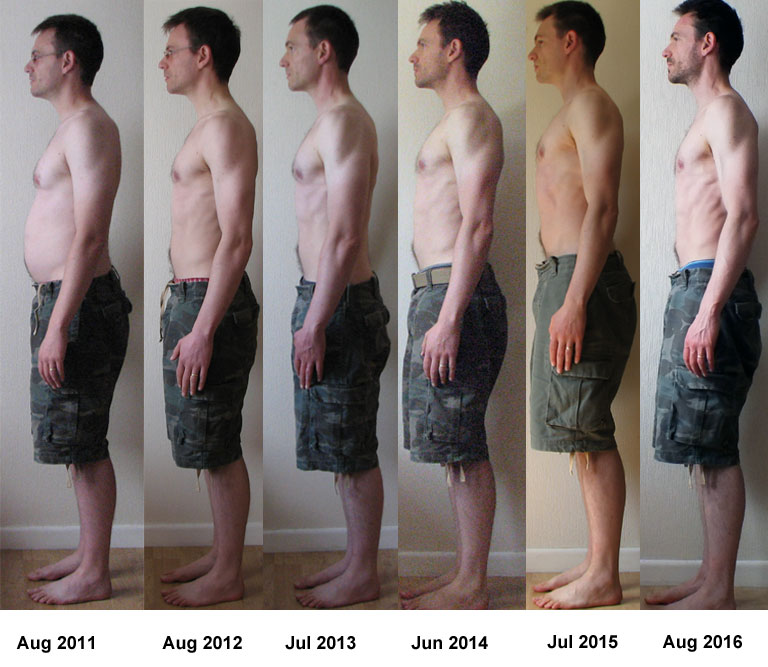
Take a look at the picture below, that’s my personal before and after using the techniques I’ll share with you in the rest of this Qigong blog post.
I’ve added to this picture each year so you can see another – more important result – of following the advice in this post. And what is this important lesson? The fact that this fat loss has been sustained. Like I’ve already said, losing fat is simple, maintaining that fat loss for years requires a good plan, one which you’ll find in this post.
Using the techniques I discovered back in August, it took me about three months to lose 14 pounds (6.35kg) of belly fat.
You’ll notice that I certainly wasn’t fat all over in my August 2011 ‘Before’ shot. I just looked like I was six months pregnant. A scenario I discovered was very common amongst men of my age and referred to by the amusing oxymoron as: ‘Skinny Fat‘.
The real ‘Wowee!’ though is that I’ve easily (and I use that word deliberately) kept this belly fat off.
And yes, I really do have the same shorts =)
If you want to lose your excess fat, if you want to be happier, if you want to get into the best shape of your life, if you want to feel stronger than ever before and you want to achieve all of this (or even just some of it) safely, sustainably, naturally and simply. Then you’ll find the answers in the rest of this blog post.
A few weeks after my 40th birthday I began a quest to find the tools that would enable me to get into the best physical, emotional, mental and spiritual shape in my life.
Now I knew that my Qigong practice ticked some of the boxes, but clearly I needed something extra. Something that would allow me to lose my ‘6 months pregnant’ belly fat look.
Here’s the formula I discovered:
Qigong + Nutrition + Physical Exercise = Best You Ever
Use it and you can experience your ‘Best You Ever’ too.
Now let’s look at each component of this formula in more depth.
Qigong
I believe that Qigong on its own will only help you to lose fat if you’re an emotional eater. So if you over-eat when you are stressed or under emotional pressure, then Qigong is an excellent tool that will bring you great results. The relaxation, breathing, meditation and Energy Flow skills will help you to overcome the root cause of your unhelpful eating habits.
And I strongly believe that when it comes to ANY problem with an emotional cause at its root (and that’s more common than you may think) Qigong is the ultimate tool you can use to heal it.
Qigong ticks the emotional, mental and spiritual ‘Best You Ever’ boxes. But it fails when it comes to developing your physical ‘Best You Ever’. I’ll share the solution to this in a moment. Because I want to make it clear that the major draw back when it comes to relying solely on Qigong for losing weight, is this:
If you don’t have an emotional problem with food, Qigong on it’s own won’t help you to lose fat.
Okay, now let’s look at the second part of our ‘Best You Ever’ fat loss formula…
Nutrition
Okay, I’m an expert on Qigong, but I am not an expert on nutrition, however I’m very good at research.
I started looking for sensible, believable advice on nutrition.
Eventually after years of dead ends, false information and over-hyped books and products I’ve found a simple, tried and tested way to lose fat. I mentioned it earlier, but let me remind you with this quote:
“If you look at the very highest quality studies available they consistently suggest that as far as we know that calorie value of food is the only food property that has ever been demonstrated convincingly to impact body fat mass. There’s no other property that’s been demonstrated to impact body fat mass.” Steve Guyenet
What this means is, if you want to lose fat you need to eat fewer calories.
Period.
Now how you do it is up to you.
But I suggest you follow tried, tested and repeatable approaches.
Luckily for you I found it in the National Weight Control Registry (NWCR).
Let me explain…
The NWCR was set up in 1994 and is made up of over 10,000 folk who all have one thing in common. In order to be accepted for registration they have to have lost at least 30lb’s (13.61kg) of weight and kept it off for a least one year or more.
Success leaves clues right?
Right.
I paid attention to what these folk were doing and here are the big ideas:
98 percent of registry participants report they modified their food intake in some way to lose fat
94 percent increased their physical activity
NWCR participants weigh themselves regularly
They watch calories
There are a variety of diets used by NWCR members to lose fat and keep it off. This is vitally important. How come? Because it means there is no perfect diet despite what any person or celebrity may tell you.
Whilst we’re on this subject, let me answer the question you might have at this point:
What’s the best diet?
I can answer this: The best diet is the one you can stick to long term.
Because the truth is all diets work – by reducing calorie intake – but not all diets can be followed for a lifetime.
And if you want to be a healthy weight you need a way of eating that you can follow for a lifetime.
So make sure you avoid anything extreme.
Adding the third part of our formula will not only support your fat loss, it will also give you many measurable health benefits, let’s look at…
Physical Exercise
“Just as a door, which is not frequently used, will rot, a person who does not exercise regularly will be sick.” Hua Tuo Famous 2nd Century Chinese Physician
Here are 7 reasons you want to add exercise to your repertoire of activities, but only if you’re interested in living a longer, healthier and more independent life =)
Longevity – 2.5 hours of moderate activity per week can reduce risk of mortality by 19%.
Brain – Exercise activates the release of proteins that can help to protect existing brain cells and promote the growth of new ones.
Anti-ageing – Regular exercise helps you to age well because it provides you with a wide range of physical and psychological benefits. From strengthening bones to improving your brain, from reducing cancer risk to boosting self-esteem, or simply to help you look good naked.
Reduce Risks – Exercise can reduce the risk factors associated with cancer, diabetes and cardiovascular disease.
Stroke – Statistics show that those who are moderately active have a 20% lower risk of stroke.
Diabetes – Regular exercise offers a strong protective role in the prevention of non-insulin-dependent diabetes.
Again, how you get your physical exercise is up to you.
There are many routes you can follow and it doesn’t have to involve joining a gym.
But because you’re smart you’ll want to avoid the ‘no pain, no gain’ and ‘feel the burn’ methods of physical exercise.
Personally, if you haven’t exercised for a while, practicing Qigong forms can be a good place to start.
So can taking a 10 minute walk three times a week and building up from there.
Shaolin Kung Fu and Tai Chi Quan practiced as martial arts can also be very good forms of exercise, especially if combined with Qigong.
However my personal physical exercise of choice and one I highly recommend for those not interested in martial arts is good old fashioned, calisthenics.
Yes, I’m talking about:
Push ups
Press ups
Squats
Leg raises
Bridges
The word ‘callisthenics’ comes from the Greek kallos meaning ‘beauty’ and sthenos meaning ‘strength’. And that’s a very good description: Beauty and strength.
This type of physical exercise is also known as: Bodyweight training.
One of the many attributes of Qigong that I love is that you don’t require ANY extra equipment to practice it. A safe, clean place and enough room to stretch your arms out and that’s about it. No matter where you go or where you travel you can practice Qigong.
And the same applies to callisthenics.
With callisthenics you don’t need a gym. You ARE the gym. You don’t need any weights, you use your own body weight.
After months of extensive research and trial and error I found the very best source for a complete, safe, progressive, step-by-step program of callisthenics. No matter where you may be starting from physically this program will help you to develop a beautiful and strong body. All you need to do is follow the instructions, put in the effort and be disciplined.
Something Qigong practitioners like you and I are good at.
See the resources section at the end of this post for full details.
I’ve been practicing callisthenics since August 2011 and have noticed significant increases in strength. I’m also much happier with the way my body looks.
Finally, I’d like to share: The Golden Rule of Exercise…
Don’t get injured.
Whilst the benefits of regular exercise are well documented, be careful to avoid over doing it.
Onwards…
16 years of practicing Qigong having spent the last 5 years interested in fat loss has reached me to the conclusion that:
Qigong Is Not A Panacea
Now if you’re a hardcore Qigong fan like me then this message may be hard to hear.
But if you’re still reading this, then I’m guessing you’re open minded enough to accept there’s more than one way to live and age well.
Listen, I love Qigong.
Consider the following evidence:
16 years of daily Qigong practice
13 years of Qigong teaching experience
Over £18,000 invested in my Qigong education
Authored 4 books on Qigong
Created the most comprehensive online Qigong home study course available
Shared over 800 blog posts on this website alone.
I’ve been writing a Qigong newsletter in one form or another since March 2005
So make sure you hear me when I say: I still believe Qigong is the most brilliant tool available for overcoming: mild to moderate depression, anxiety, worry and fear.
I think it’s without equal for improving a persons ability to thrive in spite of the stresses and strains of 21st Century living.
And when it comes to enhancing mental ability and promoting spiritual cultivation I believe Qigong, as a tool, is unbeatable.
But unless your weight is linked to emotional eating – Qigong on its own is not an effective way to lose fat.
That’s the bad news…
The good news is that when you combine Qigong with Exercise and Nutrition it becomes even more powerful and effective.
You see I’d always mistakenly believed that it was taboo to combine Qigong with anything, especially with physical exercise.
I also believed Qigong was a cure for all ills.
I’ll admit. I was wrong.
I no longer believe that Qigong on its own, is an effective tool for losing fat.
Summing Up
Qigong on its own is not fast, effective, or efficient enough to use as a fat loss tool. Though if your weight is linked to emotional eating then Qigong can help.
In case it didn’t come through loud and clear… Fat loss is all about calories. Eat fewer of them than you need to maintain weight and you will lose weight. Eat more of them than you need to maintain weight and you will gain weight. How you eat less calories is up to you, remember there is no perfect diet.
June 2011 I celebrated my 40th birthday. It marked a significant milestone in my life. I could no longer deny I was unhappy about how I looked and felt. After 3 months of exhaustive research into what I was missing I began my: ‘Best You Ever’ experiment. Five years later, through much trial and error, I can honestly say that I feel stronger, healthier and more physically attractive than I did in my 20’s.
You too can experience quality of life enhancing – sustainable – change if you follow my ‘Best You Ever’ formula: Qigong + Nutrition + Physical Exercise = Best You Ever
If you’d like to lose fat and discover your physical, emotional, mental and spiritual ‘Best You Ever’, here are the tools I use and recommend:
You can view other Qigong options I have available in the Qigong15 shop.
Nutrition The National Weight Control Registry is a wealth of valuable information on this subject and you can trust them because they have no diet, pills or supplements to sell you.
The Renegade Diet: Personally I’ve been practicing Intermittent Fasting daily for 5 years and this is the source I got my original information from. If you want to improve your nutrition, overcome many dietary problems and lose weight then this is for you. But a word of warning: The author comes from a muscle building and strength background, so the focus of the website is on people who want to lose weight and build muscle. Don’t let this put you off, because the content of the ebook is the best I’ve discovered.
Physical Exercise Convict Conditioning: $39.95. Available in Hard-copy and Digital-copy. Please don’t let the name put you off.
Like most arts of value, calisthenics has also suffered from being diluted and degraded by the propaganda of fitness manufacturers who want you to believe that the only effective way to train physically is in a gym or with expensive weights or new fad ‘gizmos’. Up until it’s recent revival callisthenics was most commenly found in prisons. Hence the title. But if you can get past this you’ll discover the best resource I’ve found on the subject. I liked it so much I travelled to Sweden in 2013 to become a certified instructor of it!
Again, don’t let the focus of its message put you off. Whilst you’re probably not their target market, you can definitely benefit from this resource.
I’m very familiar with the two resources I’ve listed above. So if you have any questions and you’re a client of mine please feel free to write and ask.
Please note, I am required by the FTC to advise you that if you click on the links in the resources section above, and you subsequently choose to purchase the product I recommend then I will receive a commission. Hope that’s transparent enough.