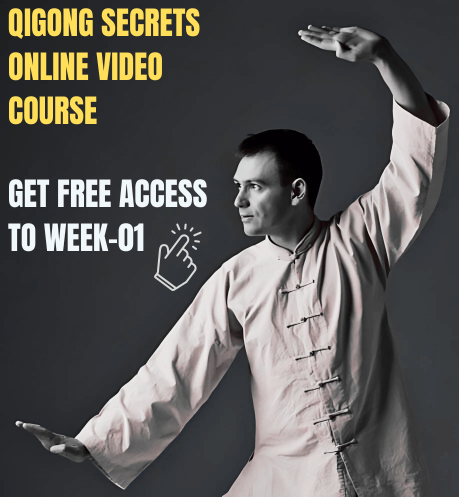
The 18 Lohan Hands is a set of 18 qigong exercises attributed to the Very Venerable Bodhidharma, who taught them to the monks of the Shaolin Temple after finding them too physically weak for the rigours of spiritual cultivation. Practiced correctly as qigong — not merely as physical form — these exercises develop strong, healthy bodies and minds, and have formed the foundation of Shaolin practice for centuries.
The first eight exercises also form the basis of the Ba Duan Jin (8 Pieces of Brocade), one of the most widely practiced qigong sets in the world.
All 18 Exercises
- Lifting the Sky (Both Hands Lift Sky)
- Shooting Arrows (Shoot Arrows Left Right)
- Plucking Stars Change Galaxies
- Rotating Winch
- Big Turn of the Cosmos (Merry Go Round)
- Punching With Wide Eyes
- Carry the Moon (Look Back to Carry the Moon)
- Reverse Hands Bend Waist (Nourishing Kidneys)
- Three Levels to Ground
- Divine Crane Starts Dancing
- Second Son Carrying Mountains (Carry Mountains)
- Lohan Draws Saber
- Fierce Tiger Pushing Mountains
- Green Dragon Separating Water
- Green Dragon Presenting Claws
- Big Windmill Hand
- Lift Heels Bend Knees
- Divine Crane Rotates Knees
Exercises by Health Condition
Different exercises in the set are particularly effective for specific health conditions. If you’re looking for the most cost-effective starting point for a particular concern, these pages break it down:
- Best qigong exercises for back pain
- Best qigong exercises for knee pain
- Best qigong exercises for arthritis and rheumatism
- Best qigong exercises for asthma
- Best qigong exercises for depression
- Best qigong exercises for diabetes
- Best qigong exercises for haemorrhoid relief
- Best qigong exercises for longevity
- Best qigong exercises for mind expansion
What “18 Lohan Hands” Means
The name breaks down as follows: 18 refers to the number of exercises in the set; Lohan refers to the followers of the Buddha Siddhartha Gautama (18 of whom were specially honoured as Buddhism spread from India to China); and Hands, in the Chinese context, refers to techniques or patterns — not the body part.
The History of the 18 Lohan Hands
The Shaolin Temple gained considerable prestige during the Tang Dynasty (AD 618–907), when Shaolin warrior monks saved the life of Li Shimin as he fought to establish the dynasty. In recognition, Li Shimin allowed the monks to maintain an army — and by the Yuan Dynasty (AD 1271–1368), the Shaolin Temple counted more than 2,000 warrior monks, all masters of Shaolin Kung Fu.
The 18 Lohan Hands eventually evolved into the 18 Lohan Fist — a kung fu set considered the prototype of Shaolin Kung Fu. Many of the monks at the Shaolin Temple were retired generals and high-ranking officials who arrived already skilled in martial arts. The combination of established fighting systems and the qigong foundation of the 18 Lohan Hands produced something that outlasted the dynasty that sheltered it.
The Shaolin Temple’s enduring contribution is often summarised as the Three Treasures of Shaolin: Shaolin Qigong, Shaolin Kung Fu, and Chan (Zen).
Learn the Full Set
All 18 exercises of the Shaolin 18 Lohan Hands are taught in the Qigong Secrets Course — a structured programme you can work through at your own pace from home. You can also find out more about learning qigong online before committing.